
Showing posts with label mushrooms. Show all posts
Showing posts with label mushrooms. Show all posts


5/9/12


4/10/11
You Have to Die to Be Reborn (Excursus)
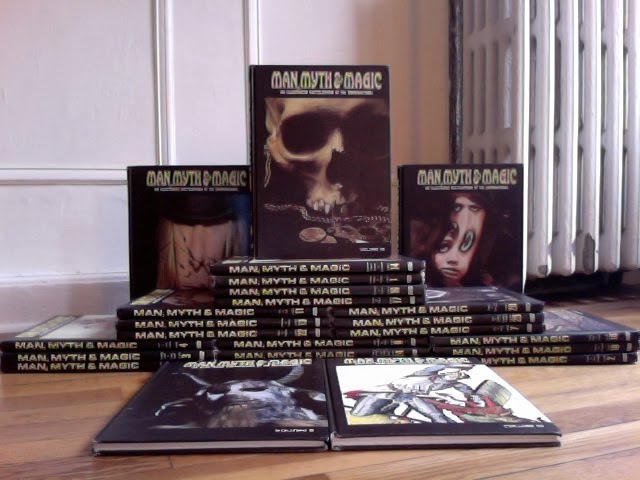
Written by Mircea Eliade, the entry for Shamanism in vol. 19 of Man, Myth and Magic bears this image and the following caption:

“A Lapp shaman with his drum and lying on the ground in trance: it is in ecstatic trance that the shaman makes his journeys to heaven and hell; he is the man who can die and return to life again, many times.” Each time the shaman makes this journey he is treading a path first broken during his psychic initiatory crisis. Eliade argues that the process of initiation occurs as a healing process to resolve a moment of madness in the individual resulting from the initial experience of being divinely called for his shamanic vocation.
The initiation is understood as a process of death and rebirth: “first, torture at the hands of demons or spirits, who play the role of masters of initiation; second, ritual death, experienced by the patient as a descent to hill or an ascent to heaven; third, resurrection to a new mode of being – the mode of ‘consecrated man,’ that is, a man who can personally communicate with gods, demons and spirits. For initiatory death is always followed by a resurrection; that is, in terms of psychopathological experience, the crisis is resolved and the sickness cured. The shaman’s integration of a new personality is in large part dependent on his being cured.”
The depiction on the right of the shaman in ecstatic trance should be familiar to anyone with a passing familiarity with contemporary drug culture: the prostrate shaman covered by his own drum resembles a passed-out druggie, his senses overwhelmed, the flickering flame of his ego temporarily snuffed. It is a reminder of one of the most recurrent tropes that emerged in psychedelic-spiritual culture of the late sixties and seventies: the process of death and rebirth. Since their incursion into twentieth-century America via the worlds of Harvard psychology, the Millbrook estate and the International Federation of Internal Freedom, the experiential effects of psychedelics have been understood in religious analog.
—————

A fundamental component of man’s religious consciousness, the death-rebirth process can be found across a great deal of literature dealing with psychedelic experience. Published in 1968 by the League of Spiritual Discovery, Inc, Timothy Leary’s High Priest, “the first of a four-volume biblical account of the birth, structural growth, exile, return, persecution, redemption, and flowering of the LSD religious cult,” thoroughly intertwines drug and religious rhetoric until they are inseparable – part of an effort, as one of the side-column notes phrases it, to develop a vocabulary to describe “all the modalities of a divine inebriant.” High Priest does not discuss the death-rebirth process in a psychedelic context so much as literarily enact it in liturgy and exegesis. Chapter pages bear layouts that collage I Ching quotes and oracular imagery and titles like Death of the Mind: Abysmal Prelude, and You Have to Go Out of Your Mind to Use Your Head.

Timothy Leary - High Priest - Chapter 4
—————


Timothy Leary - High Priest - Chapter 4
—————

Marcia Moore opens Journeys into the Bright World, her 1978 account of ketamine experimentation, with the title You Have to Die to Be Reborn. Here the image of self-transfiguration becomes an imperative, and the stakes of this process, the death of the self, become absolute.

—————

—————

—————


The details of her experience are colored in the hyperbolic tones of eroticized mysticism characteristic of Calfornian New Age philosophy. Moore describes the come-down process, by which the soul finds itself reborn into the material world by saying "at that point it didn’t seem remotely possible that I could ever return to the phenomenal world of things and doings in which I had formerly functioned…As I began to look out of my eyes once more I became aware that Jane was sitting silently beside me. It seemed terribly important that she should be there, and that we should be sharing this sacred interval together. I fancied that we were fellow priestesses in ancient Egypt, that she was my hierophant who would usher me back to the world of the living. Images of colonnaded temples, sphinxes, pyramids and winged figures floated behind her. I loved her enormously and felt that we had been through something like this before in one of the mystery schools of legendary eras. Surely we would remain soul sisters forever. “You are my initiator,” I whispered, certain that she would understand.”

Marcia Moore, 1968
—————

In his 1980 book LSD Psychotherapy, the culmination of more than twenty-years of clinical research in therapeutic practice with psychedelics, Stanislav Grof promoted the notion that the death-rebirth process experienced by the analysand during a clinical LSD session and rendered in the eye of the mind through cosmic imagery was in fact a conduit to perinatal experience – the originary traumatic memories of human birth encoded within the individual. Grof subdivided the perinatal trajectory into four stages or Basic Perinatal Matrices (BPM). According to Grof, the image below reflects the experience of volcanic ecstasy during BPM III, which “is frequently associated with visions of purifying fire (pyrocatharsis). During this stage, while releasing enormous amounts of destructive energy, LSD subjects identify with erupting volcanoes, atomic explosions, thermonuclear reactions, and even cosmic catastrophes.”

—————
The sole tattoo on my body is a Rosicrucian hourglass and scythe inked on the back of my left upper forearm. The image was chosen seven years ago at a time when I was reading Walter Benjamin’s Origin of German Tragic Drama, in a kind of metonymic homage to Benjamin and the theories of Baroque allegory and eschatology he explores in the text. The origin of Rosicrucianism in

—————
Recorded last summer in

Night Plane on Soundcloud


1/23/11
Soma: Wasson

"What was the original Soma? The present consensus is that it was Ephedra. Its active ingredient is ephedrine, which is derived from the stem of the plant. It stimulates the metabolism, raises blood pressure, and has other medical uses. It grows all over the world and is abundant in Central Asia. In 1968, Wendy Doniger published a chapter on "The Post-Vedic History of the Soma Plant," which reviews more than 140 such theories published between 1784 and 1967. The most common candidates include alcoholic beverages and species of Ephedra, Peganum harmala (mountain rue), Sarcostemma, Periploca, and other leafless climbers superficially resembling each other yet belonging to genera botanically far apart. Less common candidates are Cannabis sativa (hemp), the Afghan grape, Calonyction muricatum or Ipomoea muricata, whose seeds are used as purgatives, Eleusine coracana, the common millet, and even "Egyptian beer," a fermentation of date juice and palmyra or coconut palm that was allegedly brought to India from Mesopotamia. Many of these hypotheses are easy to refute (for example, the idea that Soma was a kind of alcohol). The Vedas distinguish Soma from the alcoholic sura drink that produces an evil, dur-mada, form of intoxication, whereas Soma leads to mada--rapture or bliss.
"Wendy Doniger wrote her chapter at the request of R. Gordon Wasson, a Wall Street banker with, at first, an amateur's interest in mushrooms and ethnomycology that had been kindled by his Russian wife, Valentina Pavlovna. Wasson discussed Soma and the fly-agaric mushroom with Aldous Huxley, who had written about it in Brave New World in 1932 and was about to publish his novel The Island, which describes a Sanskritic cult based upon a hallucinogenic mushroom. Wasson's interest in Soma was instrumental in his decision to retire from his bank in June 1963, and, as he put it, "translate myself to the Orient for a stay of some years". One result of his researches was the profusely illustrated and magnificently produced volume Soma: The Divine Mushroom, which incorporates Wendy Doniger's chapter. This sterling contribution heralded a new approach to the problem of the identity of Soma.
Wasson defended the thesis that the Vedic Soma was the "fly-agaric" mushroom, Amanita muscaria, familiar from the birch forests, alpine meadows, and folklore of the cooler regions of Eurasia from Western Europe to Siberia. The fly-agaric grows in mycorrhizal underground relationship with birches, conifers, and other trees that also grow in the higher mountains of more southerly regions such as the Hindu Kush and Himalayas, regions Indo-Aryan speakers crossed before entering the Indian subcontinent. Summarizing Rigvedic passages, Wasson wrote: "The poets say that Soma grows high in the mountains. They make a point of this. They never speak of its growing elsewhere. They must mean what they say".
A characteristic feature of the mushroom is its brilliant red color. It emerges from the soil as a little white ball, swells rapidly and bursts its white garment, fragments of the envelope remaining as white patches on the red skin underneath. Wasson's magnificent plates of the mushroom depict it and illustrate poetic expressions such as "the hide is of bull, the dress of sheep" (Rigveda 9.70.7). According to Wasson, Soma came in two forms. In the first, the juice itself is drunk; in the second, the urine of a person who has used the first form is drunk. This is not as far-fetched as it may seem. Wasson knew that Siberian shamans chewed the mushroom and others drank his urine. The psychoactive properties are not affected by the process of digestion and toxic side-effects may be lessened. There are other psychoactive substances that have this property, which is referred to as psychotropic metabolite. It may help explain that Indian Prime Minister Morarji Desai (like many others in India and China) drank his own.
- Frits Staal, "How a psychoactive substance become a ritual: the case of Soma." Social Research Fall 2001
"I believe that Soma was a mushroom, Amanita muscaria (Fries ex L.) Quel, the fly-agaric, the Fliegenpilz of the Germans, the fausse oronge or tue-mouche or crapaudin of the French, the mukhomor of the Russians. This flaming red mushroom with white spots flecking its cap is familiar throughout northern Europe and Siberia. It is often put down in mushroom manuals as deadly poisonous but this is false, as I myself can testify. Until lately it has been a central feature of the worship of numerous tribes in northern Siberia, where it has been consumed in the course of their shamanic sessions. Its reputation as a lethal plant in the West is, I contend, a splendid example of a tabu long outliving the religion that gave rise to it. Among the most conservative users of the fly-agaric in Siberia the belief prevailed until recent times that only the shaman and his apprentice could consume the fly-agaric with impunity: all others would surely die. This is, I am sure, the origin of the tabu that has survived among us down to our own day."
"I believe that Soma was a mushroom, Amanita muscaria (Fries ex L.) Quel, the fly-agaric, the Fliegenpilz of the Germans, the fausse oronge or tue-mouche or crapaudin of the French, the mukhomor of the Russians. This flaming red mushroom with white spots flecking its cap is familiar throughout northern Europe and Siberia. It is often put down in mushroom manuals as deadly poisonous but this is false, as I myself can testify. Until lately it has been a central feature of the worship of numerous tribes in northern Siberia, where it has been consumed in the course of their shamanic sessions. Its reputation as a lethal plant in the West is, I contend, a splendid example of a tabu long outliving the religion that gave rise to it. Among the most conservative users of the fly-agaric in Siberia the belief prevailed until recent times that only the shaman and his apprentice could consume the fly-agaric with impunity: all others would surely die. This is, I am sure, the origin of the tabu that has survived among us down to our own day."
- Gordon Wasson, "Soma of the Aryans: An Ancient Hallucinogen." Bulletin on Narcotics vol. 22(3)
Soma: Höller


"Carsten Höller's latest exhibition at the Hamburger Bahnhof Museum in Berlin takes its title from the mythical drink referred to in ancient Hindu texts, a liquid that is supposed to have been consumed by gods and mortals seeking enlightenment. It is said that reindeer urine and hallucinogenic mushrooms formed the base of the elixir, and it is up to the viewer in Höller’s installation to infer whether or not the roaming animals have imbibed elements of this mythical drink. Who, he seems to ask, is the control group in this experiment? Höller has devised a fantastical scenario that stands at the crossroads between art and science, laboratory and dream, supposed objectivity and heightened subjectivity.
Linguists, anthropologists, mycologists, and botanists alike have been searching for the composition of soma for millennia. Sifting through Sanskrit verses, they aimed at uncovering its compounds, but no consensus has yet been reached. In his life-size experiment, Höller continues the research done by American scientist Gordon R. Wasson, whose 1968 thesis on the origin and makeup of the potent potable informed the artist’s inquiry. Höller’s fantasy land can also be your home for one night – for the price of 1,000 euros (stay includes a nighttime tour of the museum with a guard, as well as breakfast)." (Artobserved)
1/13/11
American Bricolage

»Acid Cabinet« 2005 by Tom Sachs
Whitewall: Your body is at service to your art? There is this fantasy of the artist who
endures all kind of abuses (such as drugs) as a part of the experience. You need a good body to do good art?
Tom Sachs: Yeah [laughs], but the opposite is also true — I also have to be very indulgent and explore. But I don’t think drugs are an escape; I think they are an exploratory tool.
WW: They can be both.
TS: I certainly explored them in both ways — but now that I’m old, I look at it as two separate experiences. One is about using as a social lubricant, as an escape, or to eliminate pain. But then, more rigorously, I use drugs as an exploration tool, as an opportunity to go deeper inside, or, most radically, to help see the different dimension of the reality I’m used to every day.
WW: Are you talking about psychedelics like mushrooms?
TS: Mushrooms and LSD. Psychedelics are the most dangerous, effective, and quickest ways to get to those places.
WW: They’re a shortcut. It’s funny that we’re talking about different dimensions, because while preparing for this interview I had the insight that in some ways you are like a modern alchemist. Alchemists are people who can transform lead into gold, inside and outside. Is there some sort of alchemy in your work?
TS: I’m honored by your analysis, because it’s a word that I use very often when I’m explaining what “bricolage” means [Note:Sachs often describes his work as “American bricolage”]. It’s common in French, but it’s not an American word. When people ask, “What does it mean?” I say, “It’s like alchemy meets do-it-yourself but it’s not just do-it-yourself because there’s an element of spirit or tradition to bricolage.” There’s a spiritual quality to it. It’s about showing resourcefulness and love. It’s also a word for a culture that repairs rather than replaces. I come from a culture that replaces . . . when you save something, there is a little bit of magic in it. When alchemists were trying to find gold out of lead, they found other things along the way.
WW: Real alchemists are looking for inner transformation.
TS: The ultimate creation is life. To make a baby is the most magical creation there is. Everything else, whether it’s going to the moon or building a bridge over a giant valley, is impressive but . . . technology is a shadow of natural technology — nature.
Whitewall magazine, 2010
http://www.speronewestwater.com
12/24/10
the psychedelic secrets of Santa Claus

"Although most people see Christmas as a Christian holiday, most of the symbols and icons we associate with Christmas celebrations are actually derived from the shamanistic traditions of the tribal peoples of pre-Christian Northern Europe. While the modern image of Santa Claus was created at least in part by the advertising department of Coca-Cola, in truth his appearance, clothing, mannerisms and companions all mark him as the reincarnation of these ancient mushroom-gathering shamans.
The sacred mushroom of these people was the red and white amanita muscaria mushroom, also known as "fly agaric." These mushrooms are now commonly seen in books of fairy tales, and are usually associated with magic and fairies. This is because they contain potent hallucinogenic compounds, and were used by ancient peoples for insight and transcendental experiences. It was common practice among ancient people to recycle the potent effects of the mushroom by drinking each other's urine. The amanita's ingredients can remain potent even after six passes through the human body. Some scholars argue that this is the origin of the phrase "to get pissed," as this urine-drinking activity preceded alcohol by thousands of years.

Reindeer were the sacred animals of these semi-nomadic people, as the reindeer provided food, shelter, clothing and other necessities. Reindeer are also fond of eating the amanita mushrooms; they will seek them out, then prance about while under their influence. Often the urine of tripped-out reindeer would be consumed for its psychedelic effects. This effect goes the other way too, as reindeer also enjoy the urine of a human, especially one who has consumed the mushrooms. In fact, reindeer will seek out human urine to drink, and some tribesmen carry sealskin containers of their own collected piss, which they use to attract stray reindeer back into the herd.
The effects of the amanita mushroom usually include sensations of size distortion and flying. The feeling of flying could account for the legends of flying reindeer, and legends of shamanic journeys included stories of winged reindeer, transporting their riders up to the highest branches of the World Tree." (Cannabis Culture)
flying reindeer

Reindeer "go to great lengths to search out the hallucinogenic fly agaric mushroom (Amanita muscaria) — the one with the white-spotted red cap that garden gnomes like to sit on. Eating the toadstool makes reindeer behave in a drunken fashion, running about aimlessly and making strange noises. Head-twitching is also common. Fly agaric is found across the northern hemisphere and has long been used by mankind for its psychotropic properties. But its use can be dangerous because it also contains toxic substances. Reindeer seem to metabolise these toxic elements without harm, while the main psychoactive constituents remain unmetabolised and are excreted in the urine. Reindeer herders in Europe and Asia long ago learnt to collect the reindeer urine for use as a comparatively safe source of the hallucinogen."


6/30/10
Industry Tape

"i acquired this tape before the turn of the century at a rave in houston, texas. the recording features the two biggest 2nd gen chicago house djs playing a 2x4 tag team vinyl set on psilocybin." (DJ Harry Bennett)
Live @ Industry with Derrick Carter on 4 decks by dj sneak
3/22/10

3/21/10


2/1/10

Subscribe to:
Posts (Atom)


