"The Evil Acid Baron Show released in 1988 was the first acid house video, created by Stakker, with music by Farley ‘Jackmaster’ Funk, Tyree, Baby Ford, Royal House and S’Express. The first video that I saw was actually the more accomplished Eurotechno, which came out the following year. Eurotechno blew me away when I first saw it at a house night in Cornwall and I went to Woolworths to buy a copy on VHS, which thankfully I still have. The pulsing, ever-changing graphics go perfectly with the futuristic acid soundtrack and is just as fresh as it was then.
Stakker were video artists Mark McClean and Colin Scott. After using other people’s music for their first video, they decided they wanted their follow-up to feature music they had commissioned themselves so that the music could more closely match the visuals. They teamed up with Brian Dougans and together produced the classic track, ‘Humanoid’ (released as ‘Stakker Humanoid’ on Morgan Khan’s label, Westside). Stakker and Dougans had already split by the time the record was released, and the Eurotechno soundtrack, which had been begun by Dougans with input from Garry Cobain, was completed by Scott and Simon Monday. (Cobain and Dougans went on to release projects under the names Smart Systems, Yage, Indo Tribe, Mental Cube and most famously, The Future Sound Of London.)
Here is the first part of The Evil Acid Baron Show. For this and the Eurotechno videos, McClean and Scott used a Fairlight CVI graphics machine, which was the video “sister” to the Fairlight CMI digital sampling synthesizer made famous by the likes of Herbie Hancock and Art Of Noise.
"Illustrator Jérôme Dubois recently began scanning and preserving the covers and contents of Ridendo, "a medical and humor magazine distributed to French physicians from 1933 to 1977." Jérôme's collection centers on the 1930s, when this improbable-sounding magazine was full of ads for improbable-sounding drugs." (50 WATTS)
"I performed this reaction as an assignment after it was referenced in Ilya Prigogine's book "The End of Certainty" as an example of a chemical reaction that gained new properties when far from equilibrium. I used various recipes from Wolfgang Jahnke and Arthur T. Winfree's 1991 paper in the Journal of Chemical Education, "Recipes for Belousov-Zhabotinsky Reagents." The later half of the video is a time-lapse of a 34 min. reaction, showing it in about 3 min."
"It was February 1966 and I was twenty–eight and was sitting on a gravelly roof in San Francisco's North Beach. I had taken a mild dose of LSD on an otherwise boring afternoon and sat, wrapped in a blanket, gazing at the San Francisco skyline. As I stared at the city’s high–rises, I realized they were not really parallel, but diverged slightly at the top because of the curve of the earth. I started thinking that the curve of the earth must be more dramatic the higher one went. I could see that it was curved, think it, and finally feel it. I imagined going farther and farther into orbit and soon realized that the sight of the entire planet, seen at once, would be quite dramatic and would make a point that Buckminster Fuller was always ranting about: that people act as if the earth is flat, when in reality it is spherical and extremely finite, and until we learn to treat it as a finite thing, we will never get civilization right. I herded my trembling thoughts together as the winds blew and time passed. And I figured a photograph—a color photograph—would help make that happen. There it would be for all to see, the earth complete, tiny, adrift, and no one would ever perceive things the same way." - Stewart Brand, designer of the Whole Earth Catalog.
The Apollo program was going full-bore by then and as NASA prepared to launch the Lunar Orbiter series of lunar-surveying spacecraft, Brand launched the "Why haven't we seen a photograph of the whole Earth yet?" button campaign - with buttons sent scientists, senators, thinkers, the media, and getting some press out of it. Finally realizing that the photo would be a good PR move, NASA instructed Lunar Orbiter 1 to take a single black and white picture of the Earth on August 23, 1966.
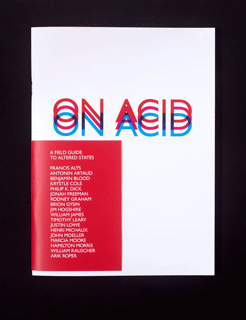
Published by Acid Age. A field report compiling the research from the Acid Age blog, and new interviews.
Contributors include Antonin Artaud, William James, Timothy Leary, Rodney Graham, and Francis Alÿs. Interviews with Justin Lowe and Jonah Freeman, Arik Roper, and Hamilton Morris.
.PNG)
.PNG)

.PNG)
.PNG)