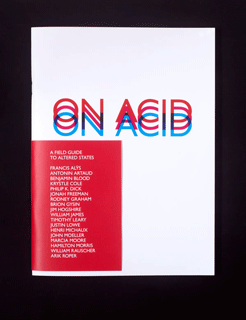
Created in the form of a futuristic encyclopedia, On Acid: A Field Guide to Altered States explores psychedelia in art and literature, drawing a line connecting archival works by William James, Antonin Artaud, Timothy Leary, and various modernist explorers, to the practice of contemporary artists such as Rodney Graham, Francis Alÿs, Jonah Freeman and Justin Lowe. The book concludes with a series of interviews with Freeman and Lowe, Hamilton Morris and Arik Roper. (read more)
Continuing the creative curatorial spirit of Harry Smith’s 1952 Anthology of American Folk Music, this anthology presents the legacy of American acid house in three themed mixes curated and performed by CCC DJ Harry Bennett. Each mix contributes to the recognition of this musical subgenre, originating in late 1980s Chicago, as itself a rich strain of folk music.
“Acid Ballads” covers vocal acid tracks, which variously depict the trials of romantic love, feelings of erotic desire, communal ecstasy, and the phantasmorgia of urban nightlife. “Werk Songs” features the subgenre’s heaviest dance numbers, whose propulsive rhythms embody the jackhammer-style of “jackin” house. In “Slow Motion Acid,” signature acid tunes are spun in a chopped & screwed style which re-imagines classic Chicago house in the vein of the pitched-down rap music pioneered by DJ Screw in the 1990s.
The historical approach of the AAAH reflects the ambiguous etymology of the word “acid” in “acid house.” While the term initially referred to psychedelic sounds and the mind-altering substances traditionally consumed in nightclub environments, “acid” began to additionally invoke an “acid burn,” the act of stealing or sampling recordings endemic to dance music production. The anthology’s own acidic character can be found in its relation to history, which the anthology subjectively samples and re-presents in a psychedelic mix.
Anthology of American Acid House Vol. 1: Acid Ballads
Victor Romeo ft. Leatrice Brown “Love Will Find A Way (Club)” (Dance Mania – 1988) The It “Donnie (Club Mix)” (D.J. International – 1986) Jeanette Thomas “Shake Your Body (House Shaker)” (Chicago Connection – 1987) Blake Baxter “When We Used To Play” (KMS – 1987) Fast Eddie “Acid Thunder (Tyree’s SuperCooper Mix)” (D.J. International – 1988) John Rocca “Move” (Criminal Records – 1985) Blake Baxter “Get Layed” (KMS – 1987) Tyree feat. Chic “I Fear The Night (Subterraranian Mix)” (Underground – 1986) Adonis “We’re Rocking Down the House (Down Break)” (Trax Records – 1986) The Party Boy “Twilight Zone (Bam Bam’s Corrosion Mix)” (Urban Acid – 1988) Bam Bam “Spend The Night” (Westbrook Records – 1988)
Anthology of American Acid House Vol. 2: Werk Songs
LNR “Work It To The Bone” (House Jam – 1987) Blake Baxter “Body Work” (KMS 1987) Mike “Hitman” Wilson “Bango Acid” (Trax Records – 1988) Endless Pokers “The Poke (The After Poke Mix)” (D.J. International – 1988) Bobby Konders “Version” (Nu Groove 1992) Phuture “Phuture Jacks” (Trax Records – 1987) The Children “Freedom (Factory Mix)” (D.J. International – 1987) Mr. Lee “Never Gonna Change” (Trax Records – 1988) Pierre’s Pfantasy Club “Fantasy Girl (Club Mix)” (SRO 1987) Phuture “Slam! (Vocal)” (Trax Records – 1988)
Anthology of American Acid House Vol. 3: Slow Motion Acid
Phuture “Your Only Friend” (Trax Records – 1987) Adonis “No Way Back” (Trax Records – 1986) Blake Baxter “When A Thought Becomes U” (Underground Resistance – 1991) Fingers Inc. “Can You Feel It” (Serious Records – 1988) Maurice “This is Acid (New Dance Craze)” (Trax – 1988) Jamie Principle “Baby Wants To Ride” (ffrr – 1988) Bam Bam “Where’s Your Child” (Westbrook – 1988) Farley “Jackmaster” Funk & Ricky Dillard “It’s U” ( D.J. International – 1987)
"The ground in Minhas is so full of iron, people are literally magnetized to the place. You'll feel that at Instituto Inhotim, it’s amazing. Someone tripping on acid at a party for Olafur Eliasson’s exhibition at the Videobrasil festival in São Paulo told me this the night before I flew to the state of Minas Gerais (General Mines)." [Artforum]
$15 On Acid presents a radically subjective re-edit of the history of drug experience, following the emergence of drugs as a technology and modernity's conflicted obsessions with altered states. Tracing a path beginning with philosopher Benjamin Blood's 1874 pamphlet 'The Anesthetic Revelation and the Gist of Philosophy' which declares the existence of a 'majesty and supremacy unspeakable' observable only after being dosed by nitrous oxide, On Acid assembles texts and images that draw a line connecting archival works by William James, Antonin Artaud, Timothy Leary, and various modernist explorers, to the practice of contemporary artists such as Rodney Graham, Francis Alÿs, Jonah Freeman and Justin Lowe. Removed from the familiar cultural contexts of Haight-Ashbury and Grateful Dead psychedelia, On Acid is in itself an experimental program, a recursive acidic process that mirrors the deconstructive relations to counterculture cultivated in contemporary art. The book concludes with a series of new conversations with Freeman and Lowe, Hamilton Morris and Arik Roper.
100 pages / full-color. Printed in Italy on Munken Arctic paper.
Published: Oct 2011
Edited by William Rauscher and John Moeller. Designed by John Moeller.
"After spending the last four months filing FOIA requests and thumbing through hundreds of pages of police reports in an attempt to solve the little-known murder of a San Antonian mycologist in the early 80s, I have come to the conclusion that crime solving is hard...Neither in my sober investigations nor in my daydreams did I ever consider the most obvious solution: self-administering an anesthetic dose of ketamine and mentally traveling back in time to witness the murder. Then I stumbled upon a non-fiction book called Into The Void by an author named Zoe7, a self described “multidimensional synergy personality cluster” composed of six distinct identities. The book details Zoe7's attempts to solve the JonBenét Ramsey murder using no other forensic equipment than a hypodermic needle filled with ketamine and his mind. As one would expect, his experiments were wildly successful and he is the only person known to have witnessed exactly what happened in the Ramsey home that fateful night in December of 1996." [HM]
"I found myself in a dark bedroom. There were two single beds in that bedroom, but the second bed was empty. What struck me as odd however, was that I saw JonBonet’s mother lying in bed asleep, holding her son in her arms. Then, as I was heading towards the door to continue my search for JonBonet, I was suddenly startled by JonBonet herself! She was wearing a white gown and thick fury flipflops. She was also carrying something close to her chest with one of her arms. I could not make out what it was, but the surprising thing however, was the fact that she could see me!...I kneeled down and carefully took JonBonet by her little shoulders and said to her that I had been looking for her, and that I wanted to find out what happened. Unfortunately for me, but fortunately for her––in a way––she did not realize that she had been murdered––at least not at that particular space-time (or perhaps probability) window I had arrived in." [Zoe7]
"KETAFORENSICS - THE ART AND SCIENCE OF USING KETAMINE TO SOLVE THE JONBENÉT RAMSEY MURDER" [VICE]
"Luckily, in one of those synchronistic events that always seem to happen on acid, the place Elektra decided to sit was quickly shared by Kelis' ass. This blew life back into the poor, tripping girl. "It looks incredible," she said, grinning. "I'm getting seriously good vibes."
There are at least two experiences of the relation between psychedelic drugs and the idea of contingency. Let's say that one is called the coercive experience, and the other is called the dispersive.
The coercive experience is paranoiac, conspiratorial. It is ontologically suspicious. It is coercive because it is interrogatory, and more often than not, is forcefully searching for a foregone conclusion. The coercive is a great architect, building meaning upon meanings, in the way the Egyptians must have built the pyramids: with a great arsenal of violence. The coercive is religious, occult, reverent. It produces symbols by utilizing the capacity for psychedelics to temporarily erase your world. Anything that wanders into your space after your world-erasure is capable of adopting an auratic glow, because of the isolated nature of your encounter with it, and as part of the coercive's erasure of contingency, the sign before you becomes destiny.
At its most defective, the coercive is based on an irrational belief that self-authorizes the creation of a cosmos and then covers its tracks. The defective mode of the coercive is religious mania, the healthy mode, artistic creation.
The coercive works by attempting to gather the Many into the One. The dispersive works in the opposite direction, splitting unities into multiplicities. The dispersive views phenomena in the world not with suspicion, but with skepticism. The dispersive suspects that ontological inconsistencies can arise: I arrive at the office and it does not surprise me if my office were suddenly on the opposite end of the hall. This is the same lack of surprise, says Picasso, he would feel if, in the bath, his body suddenly dissolved into atoms.
The dispersive recognizes and investigates contingency by feeling the absurdity behind every particular and the potential for it to have been otherwise, to have played out a different way, belong to an alternate constitution of reality. The defective mode of the dispersive finds itself splintered off into some dead-end corner of the multiverse, unable to trace its way back to the collective stream of human experience. Dispersive experience's healthy mode finds its outlet in speculation. Its speculative regard for potentiality, which considers unrealized possibilities as real as mere actuality, makes it closely akin to science fiction.
'It was given its reptilian name because its poisonous ingredients quickly turn the skin scaly. Krokodil addicts are disturbing in the extreme. Flesh goes grey and peels away to leave bones exposed. People literally rot to death.' [The Independent.co.uk]
“The first time I took psilocybin — 10 pills — was in the fireside social setting in Cambridge,” Ginsberg wrote in a blow-by-blow description of his experience taking synthesized hallucinogenic mushrooms at Leary’s stately home. At one point Ginsberg, naked and nauseated, began to feel scared, but then “Professor Leary came into my room, looked in my eyes and said I was a great man.”
* * *
“How about contributing to my next prose masterpiece by sending me (as you sent Burroughs) a bottle of SM pills,” Kerouac wrote Leary, referring to psilocybin. “Allen said I could knock off a daily chapter with 2 SMs and be done with a whole novel in a month.”
* * *
After trying Leary’s magical pink pills Arthur Koestler told his host the next day that they were not for him: “I solved the secret of the universe last night, but this morning I forgot what it was.”
Drug traffickers in Mexico have been abducting bus passengers and forcing them to fight each other like gladiators with the winners being ordered to become assassins, a drug trafficker tells the Houston Chronicle. The fights, initiated by members of the Zetas cartel, are called "Who's going to be the next hitman?" said the trafficker, who agreed to talk to the Chronicle on condition of anonymity. The gladiators use machetes, hammers and sticks. "They cut guys to pieces," the paper quotes the trafficker as saying. The winners are sent by the Zetas on suicide missions to shoot up the territory of rivals, the trafficker told the Chronicle. The losers end up in mass graves.
New to SD and looking for the pretty rave girls. If yr one hit me up I'm chase post yr pic so I can see ya! Haha I am looking for a fun girl to chill with at raves and rave parties.
Or even if your a homie and know of the rave scene hit me uup
I love glowstick lights shows orbitals and strings are sick.
Dubstep and techno are tooo insane!
Best raves so far benny, armin van buren, DEADMAU5
[excerpted from an interview with Hamilton Morris - full transcript available in the forthcoming Acid Age print journal]
AA: Some of your articles cover quasi-legal drugs produced by underground labs. What do you know about Dave Llewellyn and mephedrone?
HM: Llewellyn’s Alchemy Labz website was a well-designed scam. He broke every rule about how you’re supposed to sell designer drugs including the cardinal rule, you must de-emphasize the possibility of human consumption. Mephedrone was packaged as plant food, JWH-018 as bonsai growth enhancer, various alkyl nitrites as head cleaner and so forth. The Llewellyn crew poached their designer drug menu from various online chemistry and pharmacology forums. They even put a methylphenidate analog called ethylphenidate on the list after I wrote about its potential as a novel stimulant. Llewellyn sent me a moldy bag of supposed ethylphenidate that was nothing but wet flower. Then the Daily Mail published his warning against naphyrone, which was a red-herring and part of an elaborate meta-scam to draw attention away from all of the supposed new chemicals he was selling.
AA: I saw that. I didn’t know the background of the story but I smelled something fishy right away. It was clear he was trying to scare everyone about a drug in order to present his own products as the safe alternative.
HM: The fact is that no one knows what “NRG-1” is – any batch you get could be anything. In Spring 2010, because of the mephedrone scare, the British media was hungry for stories about novel designer drugs. So, and this is the nerdiest thing I’ve ever done, I contacted a journalist and told him that I had invented a drug that was a combination of cubane and mephedrone called “Hypercube.” But then I got uncomfortable when they believed me and called me on the phone to cover the story.
AA: What brought about the mephedrone phenomenon, with chemists reconfiguring the recipe to stay ahead of the law?
HM: All these designer drugs and quasi-legal highs are more prevalent in Europe precisely because the laws are different. In the US thousands of substances are in a grey area and the DEA can selectively prosecute using the Federal Analog Act. In order to circumvent these laws vendors throw completely novel structures onto the market with no regard for their customers.
AA: If the US has the Federal Analog Act, how does this affect someone like Alexander Shulgin, who keeps producing endless variants on MDMA?
HM: Well Shulgin only explores novel compounds, and each new molecular entity is a complete unknown regardless of its structural similarity to a lead compound like MDMA or DMT. Shulgin does not research psychedelics but rather antidepressants, should one of his putative antidepressants possess a psychedelic effect he characterizes it, discontinues research, and moves on. Additionally the DEA know if they arrested him how bad it would make them look, imprisoning this kindly old scientist, it would cause an outrage. Lastly, Shulgin has never directly profited off his drugs, which is key.
Published by Acid Age. A field report compiling the research from the Acid Age blog, and new interviews.
Contributors include Antonin Artaud, William James, Timothy Leary, Rodney Graham, and Francis Alÿs. Interviews with Justin Lowe and Jonah Freeman, Arik Roper, and Hamilton Morris.